Kept AI

GEO 101

GEO 101: the basics of AI search

Where do language models get their picture of your brand? Why do some pages earn citations? Which sources dominate your category, and how can you track it all?

Start reading chapter one

Chapters

What GEO means (and how it differs from SEO and AEO)

Generative Engine Optimization (GEO) is the work of making a brand easy for AI answer engines to find, understand, and repeat. The unit of success is not a blue link on a results page but a sentence inside a generated answer: whether ChatGPT, Gemini, Perplexity, Claude, or Google AI Mode names your product, describes it correctly, and points to a source you own or influence.

SEO optimises a ranked list, and a person still decides where to click. AEO — answer engine optimisation — is narrower: winning the one direct answer, the way featured snippets do. GEO sits on top of both, because a generative answer is assembled rather than retrieved: the model writes a paragraph, picks a few sources to support it, and often names two or three brands instead of one.

So you are optimising a distribution of answers, not a fixed position. The same prompt asked twice can return different wording, different brands, and different citations, which is why GEO is measured on samples collected over time rather than on a single screenshot. Classic search fundamentals still apply, because retrieval leans heavily on the open web and on ordinary crawling.

How AI answer engines learn about your brand

Example interface: three buyer questions grouped by research intent
60 answers3 models7 days

Two mechanisms are at work, and they behave very differently.

  • Training data. What a model absorbed before its cut-off date shapes what it already believes about your category: which brands are canonical, what they are known for, who competes with whom. You cannot edit it directly, and what you publish today may take a long time to reach a future training run.
  • Live retrieval. Most answer engines also search at answer time: the system expands the question into several queries, fetches pages, reads excerpts, and writes an answer with citations attached. This is the layer you can influence in weeks rather than years.

Most consumer AI products blend the two, and the balance shifts by question type. Retrieval carries the most weight for anything time-sensitive, comparative, or long-tail — pricing, integrations, alternatives, reviews, “best tool for X” — which is where commercial prompts live.

Citations are the visible edge of retrieval, not the whole of it: a page can inform an answer without ever being linked. That is why it helps to separate brand visibility (your name appears) from source visibility (your domain is used or cited); Kept AI records both for every sampled answer.

What makes a page get cited

No engine publishes its selection logic, and the details change often. Still, the qualities that keep showing up in cited pages are not exotic.

  • Entity clarity. The page states plainly what the product is, who it is for, what it costs, and how it differs from the obvious alternatives. A model can only repeat a claim it can locate in a sentence.
  • Extractable structure. Short answer first, detail afterwards. Headings that mirror the questions people actually ask. Tables for comparisons, lists for steps. Long hedged prose is hard to quote.
  • Specifics you can stand behind. Numbers, limits, supported platforms, named integrations. Vague marketing copy gives a model nothing to cite.
  • Freshness that is real. A visible last-updated date, current pricing, current product names. Pages that read as stale are quietly skipped for questions that imply “now”.
  • Authority and corroboration. Third-party mentions — reviews, directories, forum threads, independent comparisons — usually carry more weight than one more page on your own domain repeating the same claim.
  • Machine access. If AI crawlers are blocked in robots.txt, rate-limited, or served content only after JavaScript runs, you can be invisible for reasons that have nothing to do with your writing.

Check the last one first: it is cheap to verify, and when it fails it invalidates everything above it. Kept AI’s agent analytics show which AI crawlers reached your site and what they were served.

Where AI answers pull from, by category

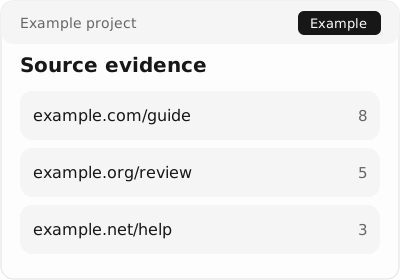
Example interface: cited paths and their sample answer counts
3 sourcesRead evidenceReview first

The source mix is category-specific, and learning yours is usually the most useful thing to do before writing anything new. A few patterns are common.

  • B2B software: vendor documentation and pricing pages, review platforms, comparison and “alternatives” articles, and — increasingly — community threads where practitioners argue about tools.
  • Consumer products: retailer listings, editorial round-ups, video reviews, and forums where people report what happened after purchase.
  • Health, finance, and other sensitive topics: institutional, academic, and government sources dominate, and brand pages are cited far more cautiously.
  • Local and travel: maps and listing platforms, user reviews, and recent posts, with a strong preference for anything that looks current.
  • Fast-moving news: news outlets and official announcements, weighted heavily toward the last few days.

Rather than assuming your mix, sample it. Kept AI records the sources behind each sampled answer, so you can see which domains actually feed the prompts that matter to you, and which surfaces you have no presence on at all.

The metrics that matter

A GEO programme runs on a small set of numbers, each answering a different question.

  • Visibility: the share of answers to your tracked prompts that name your brand. Treat it as a rate rather than a rank, meaningful only on a stable prompt set.
  • Position: where inside the answer you are named. Being the first recommendation reads very differently to a buyer than being the fifth item in a list.
  • Sentiment: how you are described — recommended, mentioned neutrally, or mentioned with a caveat. Rising mentions with worsening sentiment is not progress.
  • Share of voice: your visibility relative to the competitors you selected. It separates “we improved” from “the whole category is being mentioned more often”.
  • Brand visibility vs. source visibility: whether the answer named you, cited you, or both. Cited but not named, and named but not cited, point to different fixes.
  • Source breakdown: which domains supply the answers in your category, and how often yours is among them. This is the metric that turns into an action list fastest.

Two habits keep the numbers honest: define the prompt set before you look at the results, and compare like with like — same prompts, same models, same language and region. Kept AI samples on a fixed cadence and keeps the history, which is what makes week-over-week comparison meaningful.

A practical six-step workflow

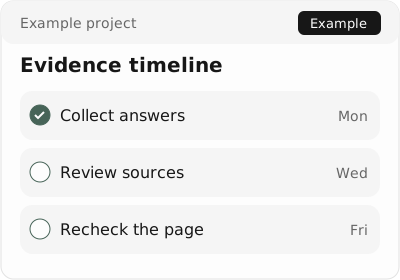
Example interface: a three-step sample collection, review and recheck history
3 milestonesKeep a record7 days
  1. Prompts. Start from what buyers type, not from keywords: category discovery, comparisons, alternatives, use cases, pricing, objections. A few dozen well-chosen prompts, tagged by funnel stage and persona, beat hundreds of near-duplicates.
  2. Competitors. Pick a short, honest list, including the default brands a model names when nobody is specified. Those defaults are your real benchmark, whether or not sales considers them rivals.
  3. Models. Track the engines your audience actually uses, and run the same prompt set across all of them. Answers and source preferences differ enough between engines that a single-model view will mislead you.
  4. Sources. For every prompt, look at which domains were used, then sort them into three buckets: pages you own, pages you can influence (reviews, directories, partner posts, community threads), and pages you cannot. The middle bucket is where most quick wins hide.
  5. Actions. Convert gaps into a small number of jobs: unblock crawlers, rewrite the page that should have been cited, correct wrong facts on third-party profiles, publish the comparison you are missing. Change a few things at a time so you can tell what worked.
  6. Reporting. Pick a rhythm — weekly to spot movement, monthly to make decisions — and review visibility, share of voice, position and sentiment together. Kept AI provides CSV exports, an API and an MCP server, so the numbers can live in your BI stack or be pulled by an agent.

Then repeat. Most changes need weeks to show up: pages must be re-crawled, and answers vary from run to run. Patience here is a measurement requirement, not a virtue.

Common mistakes

  • Tracking hundreds of prompts on day one. Large sets look thorough, mostly add noise, and cannot all be acted on.
  • Treating one answer as evidence. A single run is a sample of one; conclusions need repeated sampling across days and models.
  • Tracking prompts that contain your own brand name. You will look dominant and learn nothing about how you are discovered.
  • Writing pages for models rather than people. Thin question-and-answer padding ages badly and rarely earns third-party mentions.
  • Ignoring surfaces you do not own. If your category is answered from reviews and forums, publishing more of your own pages will not move the number much.
  • Blocking AI crawlers by accident. Bot rules, firewalls, and aggressive rate limits are a common, invisible cause of lost visibility.
  • Treating GEO as a replacement for SEO. Retrieval still depends on crawlable, credible pages, so the two programmes share most of their foundations.

Frequently asked questions

Five questions that come up in almost every GEO kickoff.

Is GEO just SEO with a new name?

No, though they overlap more than either camp usually admits. The foundations are shared: crawlable pages, clear claims, credible third-party coverage. What differs is the unit of measurement. SEO counts positions for queries; GEO counts mentions, citations, and sentiment across answers that are never identical twice. Teams that keep both programmes, and stop reporting them as one number, tend to decide better.

How soon do results start to move?

It depends on the mechanism you are affecting. Changes that run through live retrieval — fixing crawler access, publishing or rewriting a page, correcting a third-party profile — can surface once the page has been re-crawled, typically days to weeks. Changes that depend on training data or on genuine third-party coverage are much slower. Because answers vary between runs, treat a multi-week trend as the signal and a single day as noise.

Do I need content written specifically for AI?

Mostly no. Write for the person asking the question, and structure the page so a machine can lift an answer out of it: the direct answer near the top, headings phrased like real questions, comparisons in tables, facts stated once and stated precisely. The content that gets cited tends to be the content a knowledgeable human would also recommend — documentation, honest comparisons, and specific how-to material.

Should I add an llms.txt file?

It is a proposed convention for pointing language models at a curated map of your site, not a confirmed ranking factor, and support for it is not universal. Adding one is cheap and harmless if your documentation is already well organised, but it is no substitute for pages that crawlers can actually fetch and read. Fix access and structure first, and treat llms.txt as an optional extra rather than a lever.

What does Kept AI add on top of checking answers by hand?

Repeatability, comparison, and history. Kept AI samples your prompts across several models on a set cadence, records the brands and the sources behind each answer, tracks position and sentiment, and compares you with the competitors you selected. Agent analytics show how AI crawlers reach your site, and results can be exported as CSV or pulled through the API and MCP server. Checking by hand tells you what one model said once; sampling tells you whether anything is changing.

Five questions to check your understanding

Choose one answer per question for an immediate explanation. No personal information is collected; answers stay on this page.

Correct answers: 0 / 5

One answer mentions your brand. What can you conclude?

An answer names your brand but links elsewhere. Which statement is accurate?

A useful guide returns 403 to an intended crawler. What comes first?

What makes a weekly comparison more useful?

You corrected a product claim. What should happen next?

A learning checklist you can save

Check items as you go. This checklist is saved only in this browser, without an account or email address.