How AI sees your brand
See the traits AI links to your brand again and again.
Brand Perception
Learn how AI portrays your brand, trace each claim’s origin, and fix errors.
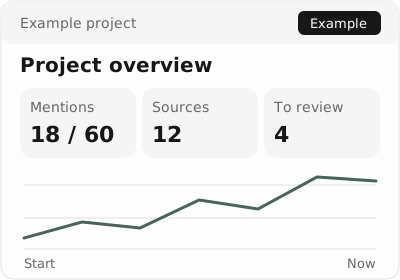
Six months of fictional brand trends. Use the metric tabs and focus a month to inspect sample values.
Compare the fictional brands in this sample
| Brand | Visibility | Sentiment | Position |
|---|---|---|---|
| 1Rosebay | 65% | 86 | 2.7 |
| 2Bluehaven | 62% | 62 | 2.9 |
| 3Northwind | 47% | 89 | 3.6 |
| 4Sunfield | 32% | 76 | 3.9 |
| 5Pinegrove | 21% | 88 | 2.3 |
| Domain | Type | Used | Avg. citations |
|---|---|---|---|
| Fforum.example | UGC | 32% | 41% |
| Jjournal.example | Editorial | 43% | 38% |
| Gguide.example | Comparison | 31% | 30% |
| Nnorthwind.example | Corporate | 28% | 24% |
| Aanswers.example | Other | 19% | 17% |
Most cited domains, grouped by type
↗ Fictional brand trends
See the traits AI links to your brand again and again.
Discover market attributes your prompts overlook.
Kept AI follows each claim to its origin, so you can see which pages are shaping the story told about your brand.
Find the attributes where rivals score better than you in AI descriptions of your category, and the ones where you lead.
Features
Example data · not customer results
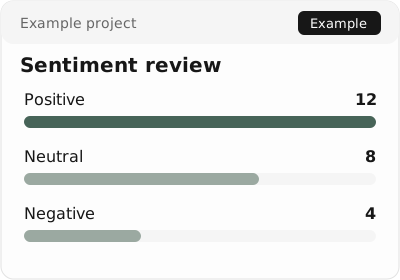
Distinguish a recommendation from a passing mention or a warning.
12 mentions: 7 positive, 3 neutral, 2 cautionary
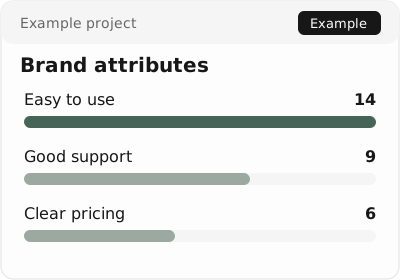
Review which product characteristics recur across sampled answers.
“Easy to configure” appears in 6 answers
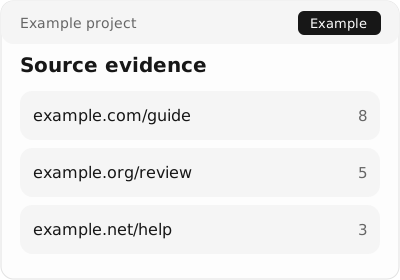
Compare the cited page with the answer before correcting outdated information.
2 answers cite an old feature page
Use a common question set to inspect how alternatives are described.
3 alternatives · 1 shared attribute checklist
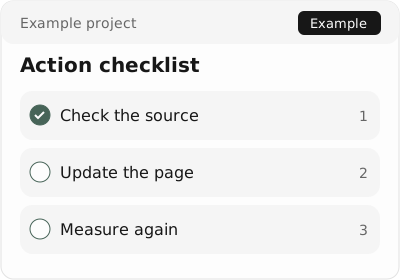
Choose a claim that matters to an actual buying decision.
Compare the answer with your current documentation.
Update the source you control, then review later answers.
Integrations
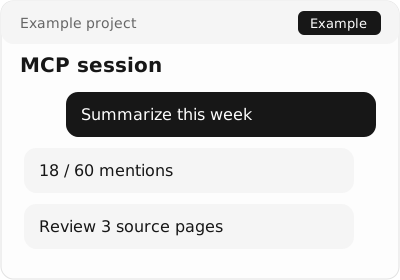
Use the data available in your project. MCP reads results; review any assistant-generated draft before exporting or sharing it.
“I would check the source behind an outdated claim before changing the brand message.”
Brand perception is the way AI models such as ChatGPT, Gemini, Perplexity, Google AI Mode and Google AI Overviews portray your brand: the traits they attach to you, the tone they take, and whether their statements are correct. Kept AI shows that picture, links each claim back to its source, and helps you correct what is wrong.
Kept AI scores brand sentiment engine by engine (ChatGPT, Gemini, Perplexity, Google AI Mode, Google AI Overviews, Claude). It pulls out each trait AI attaches to your brand — positive ones like "modern" or "powerful" and negative ones like "costly" or "outdated" — and gives each engine an overall 0–100 sentiment score.
Kept AI records brand mentions across the major AI engines and pulls out the traits AI repeatedly links to you. For each association it shows the sources behind it, so you can see which content is shaping how AI search describes your brand.
Yes. Kept AI surfaces fake reviews, outdated claims, and wrong associations AI is repeating about you - like an acquisition rumor that never happened, an incorrect product category, or a fake review. It shows you which engine is repeating it and the source URL that started it.
Kept AI pinpoints the attributes where rivals score better in AI descriptions of your category, and the ones where you lead. You can put your brand's AI perception next to competitors' for every engine you track.
Visibility tells you whether, and how often, AI answers include your brand. Perception tells you what those answers say — the tone, the traits, and whether the statements are true. You need both, but perception reveals whether each mention works for your brand or against it.